Performance
How do accuracy, response timing and errors change as task and environmental demands increase?
Doctoral research · Ulster University
Studying working memory through adaptive VR tasks.
The platform combines cognitive assessment and training with behavioural, eye-tracking, EEG and ECG recordings.
About the research ↓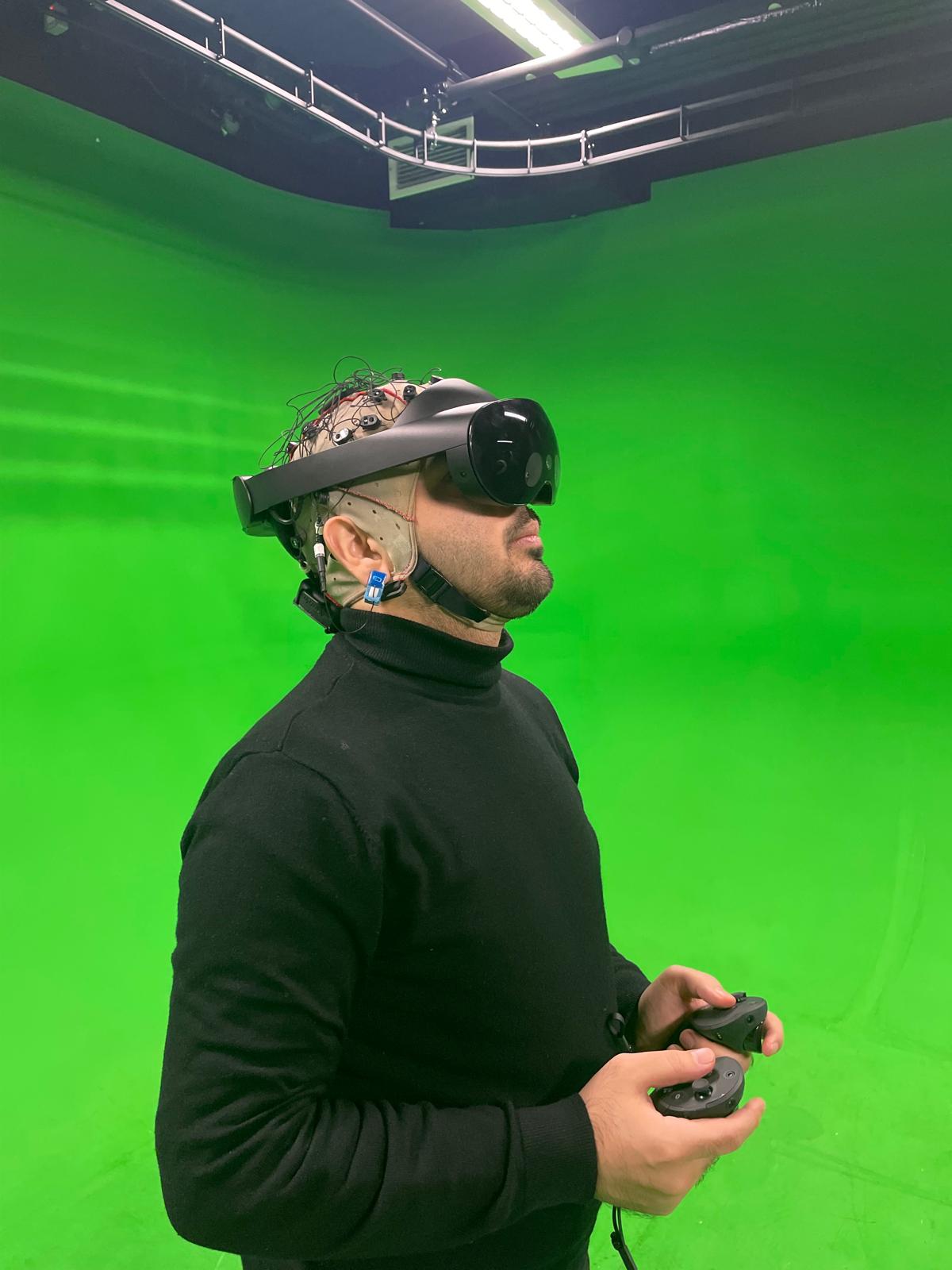
01 / Question & contribution
The same task can place different demands on different people. My research examines those differences in visuospatial working memory and attention.
I ask how performance changes with task and environmental demands, and whether physiological recordings offer useful information beyond previous behaviour and task difficulty.
Within my PhD, I design the cognitive tasks and virtual environments, implement behavioural adaptation in Unity, and develop the recording and analysis workflows connecting a session to its individual trials.
02 / Participant experience
Assessment establishes a behavioural profile; training then varies the challenge across tasks.
Equipment setup and baseline recording.
Reaction-time, spatial-sequence and N-back tasks.
A guided breathing phase before training.
Eight stages covering visual attention, tracking, spatial sequences and updating.
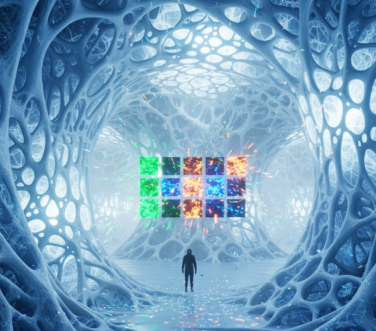
Training tasks include visual search, target–lure discrimination, change localisation, motion perception, multiple-object tracking, forward and reverse spatial sequences, and spatial N-back.
03 / Evaluation & related work
The planned evaluation follows participants across three sessions, keeping task performance, progress over time and independent transfer distinct.
How do accuracy, response timing and errors change as task and environmental demands increase?
Do aligned, quality-controlled EEG and ECG features improve prediction beyond behaviour and task difficulty?
How should adaptive and fixed training be compared, and does change extend to an independent assessment?